How Portola Valley’s Open Space Policies Shape Value
June 11, 2026
June 11, 2026
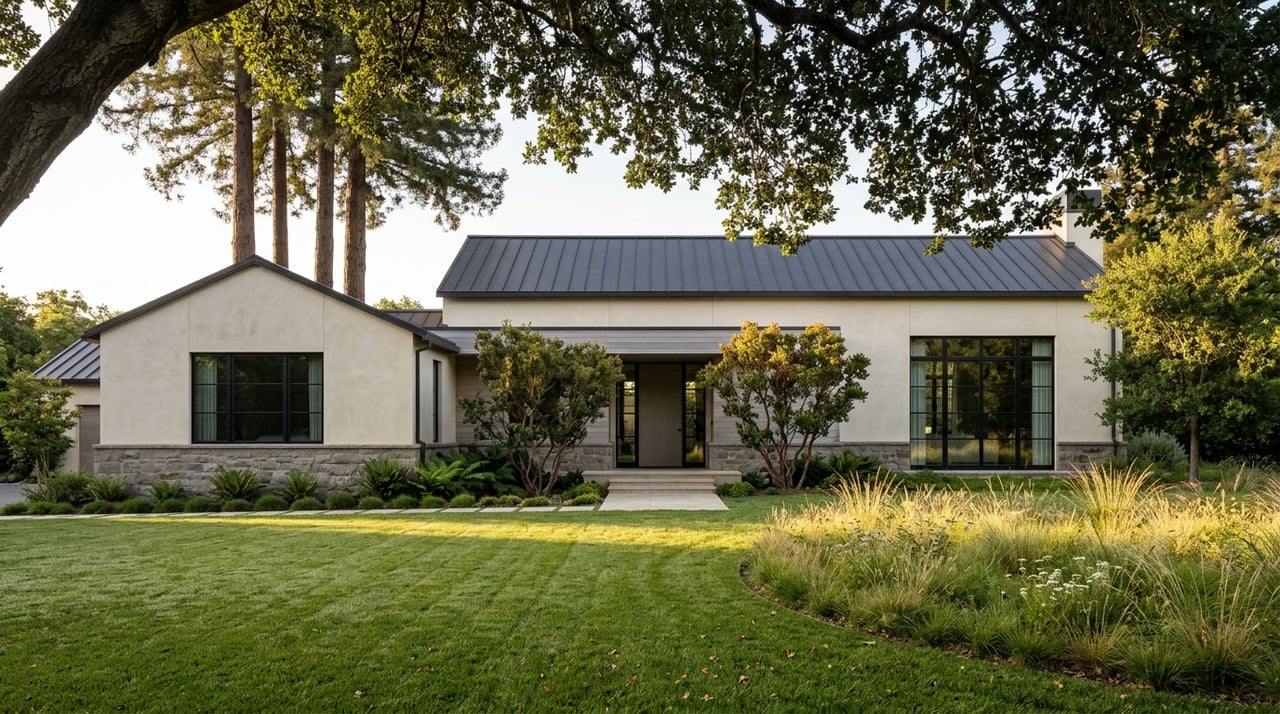
If you have ever wondered why Portola Valley feels so different from many other Peninsula markets, the answer starts with the land itself and the rules that protect it. Buyers are often drawn to the town’s privacy, natural beauty, and low-density feel, while sellers benefit from a setting that remains unusually consistent over time. To understand value in Portola Valley, you need to understand how open space policy shapes what can be built, what cannot, and why that matters. Let’s dive in.
Portola Valley was not shaped by accident. According to the town, its 1964 incorporation was driven by a desire to preserve the beauty of the land, maintain low-density housing, and limit the intensity of development.
That planning philosophy still shows up clearly today. The town covers about 9.1 square miles, and roughly 1,900 acres of permanent open space lie within town boundaries. In a market this small, protected land creates scarcity before you even get to the details of zoning or design review.
The town’s General Plan reinforces that approach. Its Open Space, Trails and Paths, Scenic Roads and Highways, Conservation, Noise, and Sustainability elements all support a rural character and a more restrained pattern of growth.
In many communities, value is tied mostly to square footage or redevelopment potential. In Portola Valley, value is often tied just as much to setting, privacy, and confidence that the surrounding environment will not change dramatically.
That distinction matters. When a town intentionally limits intensity, preserves scenic land, and protects visual character, many buyers see lasting appeal in the result.
Research on open space economics generally supports that idea. Studies reviewed by the Lincoln Institute found that preserving most types of open space usually creates value, though the effect varies based on proximity, size, and context.
In Portola Valley, the most likely value mechanism is simple: scarcity plus setting plus regulatory certainty. The town’s policies help preserve the landscape and low-density character that many buyers are specifically seeking.
Portola Valley’s zoning map helps explain why the town reads as spacious and large-lot rather than conventionally suburban. Residential density combining districts range from 7,500 square feet to 7.5 acres.
The town’s Housing Element notes that smaller-lot districts are generally found in older, more densely developed subdivision areas, while larger-lot districts are more typical in less densely developed newer areas. That structure creates a noticeably different pattern from towns built around tighter grids and broader build-out.
The Open Space Element goes further by explaining how the zoning ordinance carries out the town’s planning goals. It regulates lot sizes, permitted uses, building bulk, height, and lot coverage, while also using planned development tools to encourage clustering that leaves substantial land in a natural state.
For buyers, this means parcel size alone does not tell the full story. For sellers, it means the market often rewards homes that fit naturally into the town’s protected landscape rather than trying to push against it.
One of the biggest misunderstandings in Portola Valley is assuming that a large lot automatically means broad expansion potential. In practice, the building envelope can be much tighter than the raw parcel size suggests.
The town’s floor-area rules calculate allowed floor area and impervious surface based on parcel area, average slope, geology, flood classification, and zoning district. The main residence plus required covered parking may not exceed 85% of the lot’s Adjusted Maximum Floor Area, and the total floor area of all buildings cannot exceed the lot’s full AMFA.
The numbers can be revealing. In the town’s standards table, a 7,500-square-foot lot in the 7.5M district has a maximum floor area of 3,019 square feet, while a 1-acre lot has a maximum floor area of 5,260 square feet. Even then, actual capacity can be reduced further by slope, geology, and flood-related constraints.
That is one reason two properties with similar lot sizes can have very different long-term usability. It also helps explain why buyers place a premium on parcels with favorable topography, fewer physical constraints, and clearer expansion paths.
In Portola Valley, review is not just a technical formality. The town’s Design Guidelines state that Architectural and Site Control Commission review is intended to preserve visual character, public safety, general welfare, and the stability of land values and investments.
That language is important because it shows the town’s priorities clearly. The review process is part of how Portola Valley protects the experience of living there, not just the appearance of individual homes.
The town’s permit FAQ also shows how broad that review can be. ASCC review may apply to additions of 400 square feet or more, two-story projects, commercial buildings, parcels fronting arterial roads, tennis and paddle courts, conditional use permits, historic resources, and certain grading or vegetation-removal proposals.
For the market, this creates another layer of predictability. Buyers know the town is serious about visual restraint, and sellers benefit from an environment where neighboring changes are often subject to careful oversight.
Not every parcel experiences Portola Valley’s open space rules in the same way. Some properties feel the effects much more directly than others.
The town’s standards and handouts suggest the strongest policy effects often show up on:
If you are evaluating a purchase, these factors can influence everything from future additions to site design and outdoor improvements. If you are preparing to sell, they can also shape how buyers perceive flexibility, privacy, and long-term value.
Open space policy does not help every parcel equally. The same rules that protect scenery, privacy, and rural character can also limit redevelopment upside on certain lots.
That tradeoff is not a flaw in the system. It is central to how Portola Valley has chosen to preserve its identity.
For many buyers, that tradeoff is worth paying for. They are not only buying a house, but also buying into a landscape where density is restrained, scenic qualities are protected, and change tends to happen more carefully than in many surrounding markets.
Recent market snapshots are broadly consistent with that thesis, even if small sample sizes can make short-term figures volatile. Redfin’s latest public snapshot reported a median sale price of $6.5 million, up 31.1% year over year, while Zillow reported an average home value of $4,342,136 as of April 30, 2026, up 9.7% over the prior year.
Because Portola Valley is a small, thinly traded market, a few sales can move the numbers sharply. Even so, the larger pattern is that scarcity and setting remain central to pricing.
If you are considering a home in Portola Valley, it helps to look past finishes and focus on the property’s underlying constraints and advantages. In this market, land analysis matters as much as architecture.
Pay close attention to:
A home with less obvious expansion potential can still be very desirable if the setting is exceptional. At the same time, a large parcel may not offer as much flexibility as it first appears.
If you own property in Portola Valley, your home’s value is shaped not only by the residence itself, but also by the town-wide conditions that support scarcity and preserve character. That can be a meaningful advantage when your property offers strong privacy, favorable land characteristics, or a particularly compelling relationship to the surrounding landscape.
It also means preparation matters. Buyers in this market often look carefully at what is already improved, what may be added later, and how the property fits within the town’s planning framework.
For some sellers, the right strategy is to highlight the setting, privacy, and land quality as they exist today. For others, it may make sense to clarify entitlement potential, floor-area capacity, or site constraints early so buyers can price the opportunity with confidence.
In a market as nuanced as Portola Valley, those details are rarely minor. They often sit at the center of value.
If you are considering a purchase or planning a sale in Portola Valley, working with someone who understands both the market and the town’s development framework can make a meaningful difference. For discreet, highly local guidance, connect with Scott Dancer.

Primary phone
(650) 888-8199License Number
#00868362Address
2930 Woodside RdScott Dancer specializes in Woodside, Portola Valley, Atherton, and Menlo Park – since 1984. He sold more Woodside/Portola Valley homes than any other agent for the period of 2005 to 2021 and remains the top agent for the luxury segment of the Woodside and Portola Valley markets.
In 2012, his Woodside sale was the record-high value residential sale for the entire United States. From 2012 to 2021, Scott sold more Woodside/Portola Valley homes than any other agent or entire company and sold the highest priced home in both Woodside and Portola Valley in 2017. Scott provides his full attention and personal service to his clients, whether buyers or sellers.
Clients and agents alike get Scott’s personal full attention, not an assistant’s. Scott is a member of the National Association of Realtors, California Association of Realtors, Silicon Valley Association of Realtors, and has been a Woodside residential sales agent since 1984. Scott resides in Woodside with his wife of over 30 years and has two children.
Stay up to date on the latest real estate trends.
September 17, 2026
September 10, 2026
September 7, 2026
Getting Your Home Pricing Strategy Right From Day One in Woodside.
Scott Dancer | September 7, 2026
What to Know About a Home Inspection Before Buying in Woodside, California.
Scott Dancer | September 7, 2026
A Guide to the Architectural Styles in Woodside, California.
Scott Dancer | September 7, 2026
Questions to Ask Before Buying a Home in Woodside, California.
September 3, 2026
August 27, 2026
Scott Dancer | August 24, 2026
The Redwoods, Trails, and Town Character That Show What Makes Woodside So Special.