How Ladera and Portola Valley Pay for Themselves
November 19, 2026
November 19, 2026
Every home in 94028 has a Portola Valley mailing address, but Ladera sits outside the town's limits. Ladera is an unincorporated part of San Mateo County. Its pool, courts and pathways belong to a public district with its own elected board, and most of the cost is covered by memberships that owners decide on each year. The Town of Portola Valley, next door, spent 2025 and 2026 looking for new revenue, and when it put a price on Ladera, the shopping center was worth more to the town than the homes. A buyer comparing the two areas is comparing two ways of running a community.
The difference goes back to 1944, and it shows up in nearly everything a Ladera owner pays for.
Ladera started as the Peninsula Housing Association, a cooperative incorporated on April 17, 1944. It set out to buy land and build a community of 400 homes for its members. The architects John Funk and Joseph Allen Stein signed with the association in 1947. They drew 13 house types with flat roofs and indoor-outdoor plans. According to the Ladera Community Association's history, the cooperative ran into financing problems, rising prices and delays, and sold its assets to Portola Development Company in 1950. The Almanac reported in March 2026 that Ladera later received about two dozen Eichler homes designed by Jones & Emmons. About half are split-level or two-story, mostly along Aliso Way and La Mesa Drive.
The cooperative failed, but the planning it left behind still shapes Ladera. About 80 acres, close to a third of the development, were set aside for parks and open space. Lots ranged from 80 by 110 feet up to 2.6 acres and averaged about a third of an acre. Smaller lots meant more households close together, which is enough to support a shared pool. Because Ladera had no town government, it built its own institutions to run one.
A Ladera owner deals with three separate organizations, and each one charges in a different way.
The Ladera Community Association is a nonprofit that encourages residents to join. It publishes the Crier and a directory and helps organize community events. It also says plainly that it has no administrative or regulatory authority. Its nine-member board meets monthly at the recreation district's office.
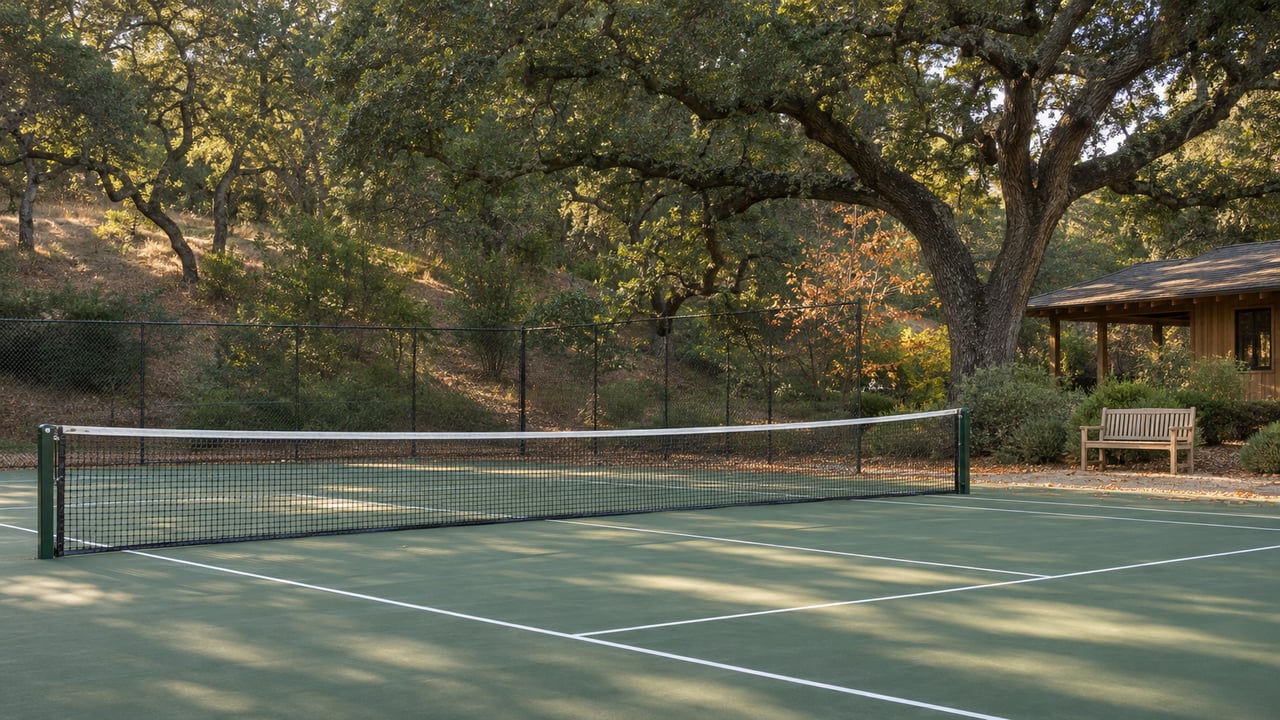
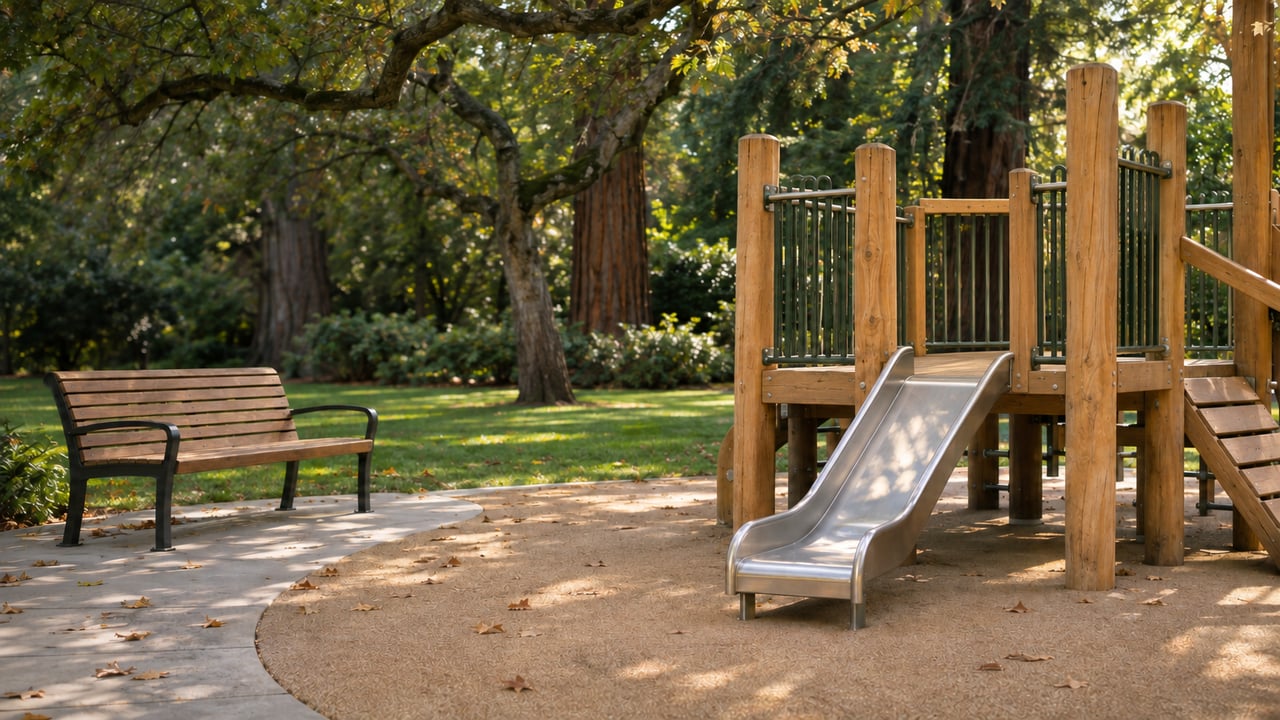
The Ladera Recreation District is a public agency. Voters and the Board of Supervisors formed it in April 1958 as an independent community services district. Its boundary covers 552 parcels, and it has stayed the same except for one 1960 annexation of Stanford land at 150 Andeta Way, where the district's facilities were built. Those facilities are a six-lane pool, a wading pool, tennis and pickleball courts, a recreation room, a playground, a bocce court and volleyball courts. The district also maintains about two miles of pathways. A membership, or a drop-in fee for Ladera residents, is required to use the facilities.
Ladera Oaks is a private club owned by its members.
| Organization | What it is | Published cost, as of fall 2026 |
|---|---|---|
| Ladera Community Association | Voluntary nonprofit | Dues not published |
| Ladera Recreation District | Public district run by an elected board | Resident family membership $1,098, nonresident $2,594, prorated for Sept. 1, 2026 to Feb. 14, 2027; resident drop-in $20 per person |
| Ladera Oaks | Private, member-owned club | $35,000 initiation, $380 monthly dues, $90 capital assessment; new proprietary memberships by waitlist only |
The recreation district's rates come from its membership page. A Ladera resident without a membership can pay $20 per person, age 3 and up, for a day of pool and tennis but cannot bring guests. Nonresidents without a membership cannot drop in. The Ladera Oaks figures come from the club's membership pages and its October 2026 membership guide, which also says 25% of the current initiation fee is returned when a member resigns.
The recreation district's finances show how the arrangement works. The San Mateo LAFCo service review released July 8, 2026 attributes about 75% of district revenue to recreation fees and 24% to property taxes. The district receives about 3% of the base 1% property tax. The same review reported more than $1.4 million in district reserves as of December 2025. Ladera's shared recreation is mostly paid for by the people who use it, one membership year at a time, and its budget answers to a five-member board elected from inside the district.
The Town of Portola Valley has run a General Fund structural deficit since fiscal year 2021-22, and the Sheriff's contract is one of its fastest-rising costs. The Almanac reported in July 2026 that the contract had risen 85% over five years. The assistant town manager put the ongoing gap at about $700,000 a year and said reserves were forecast to run out by 2030 without new revenue.
While looking for new revenue, the town's Finance Committee priced out annexing Ladera. The Town Council reviewed the committee's chart on July 23, 2025. It estimated that annexing only Ladera's commercial area would bring about $220,000 a year in sales tax, based on $22 million in annual sales at 1%, minus the cost of added services. Annexing all of Ladera was estimated at about $830,000 a year in added town taxes, with service costs not yet known. LAFCo's January 2026 service review of the town noted that annexation would bring the shopping center's sales tax into town revenue. It also noted that the town's share of property tax is 7% and that added Sheriff costs could follow.
For the town, then, the shopping center counts for more than the houses. LAFCo describes it as about 17 storefronts on fewer than 10 commercially zoned parcels. Ladera's 552 parcels already support their own recreation district with seven-figure reserves, and the storefronts at the Ladera Shopping Center were what gave the town's chart its clearest number.
At the July 2025 meeting, according to The Almanac, most council members leaned toward other options, including charter-town status. As of its July 2026 report, LAFCo described annexation as hypothetical and said it knew of no proposal to start one. The council chose the charter route. On July 22, 2026, it voted unanimously to put Measure N, a charter-town and real property transfer tax measure, on the November ballot. In the county's semi-official results as of November 13, 2026, Measure N was leading with 59.32% yes to 40.68% no. The San Mateo County Elections Office has scheduled certification for December 3. The Almanac reported that the money would go to storm drains, vegetation management and keeping the town's current level of Sheriff's Office service.
Does buying in Ladera come with a Ladera Oaks membership? No. Ladera Oaks is a private club with its own waitlist for proprietary memberships. The Ladera Recreation District is the public option, and it sells memberships to residents and nonresidents at separate rates.
Is anything changing at the Ladera Community Church property? The Almanac reported in March 2026 that the congregation approved an agreement with Habitat for Humanity to build two affordable homes of about 1,200 square feet each on church land. Construction is targeted for around late summer 2028.
Where does the Ladera Recreation District board meet? The five-member elected board usually meets on the second Monday of each month at 7 p.m. at 150 Andeta Way. Its members are unpaid.
If you are weighing a Ladera home against one inside Portola Valley's town limits, the comparison reaches past the house to lot size, the clubs and districts that come with the address, and what each one costs. Scott Dancer has worked in Portola Valley since 1984 and can compare specific properties with you, from what a lot will allow, covered in our look at Portola Valley's slope rules, to a current valuation of the home you own now. Let's Connect.

Primary phone
(650) 888-8199License Number
#00868362Address
2930 Woodside RdScott Dancer specializes in Woodside, Portola Valley, Atherton, and Menlo Park – since 1984. He sold more Woodside/Portola Valley homes than any other agent for the period of 2005 to 2021 and remains the top agent for the luxury segment of the Woodside and Portola Valley markets.
In 2012, his Woodside sale was the record-high value residential sale for the entire United States. From 2012 to 2021, Scott sold more Woodside/Portola Valley homes than any other agent or entire company and sold the highest priced home in both Woodside and Portola Valley in 2017. Scott provides his full attention and personal service to his clients, whether buyers or sellers.
Clients and agents alike get Scott’s personal full attention, not an assistant’s. Scott is a member of the National Association of Realtors, California Association of Realtors, Silicon Valley Association of Realtors, and has been a Woodside residential sales agent since 1984. Scott resides in Woodside with his wife of over 30 years and has two children.
Stay up to date on the latest real estate trends.
November 19, 2026
November 12, 2026
November 5, 2026

Scott Dancer | October 30, 2026
Here’s Where We Recommend Clients in Woodside.
October 29, 2026
October 22, 2026
October 15, 2026
October 8, 2026
October 1, 2026